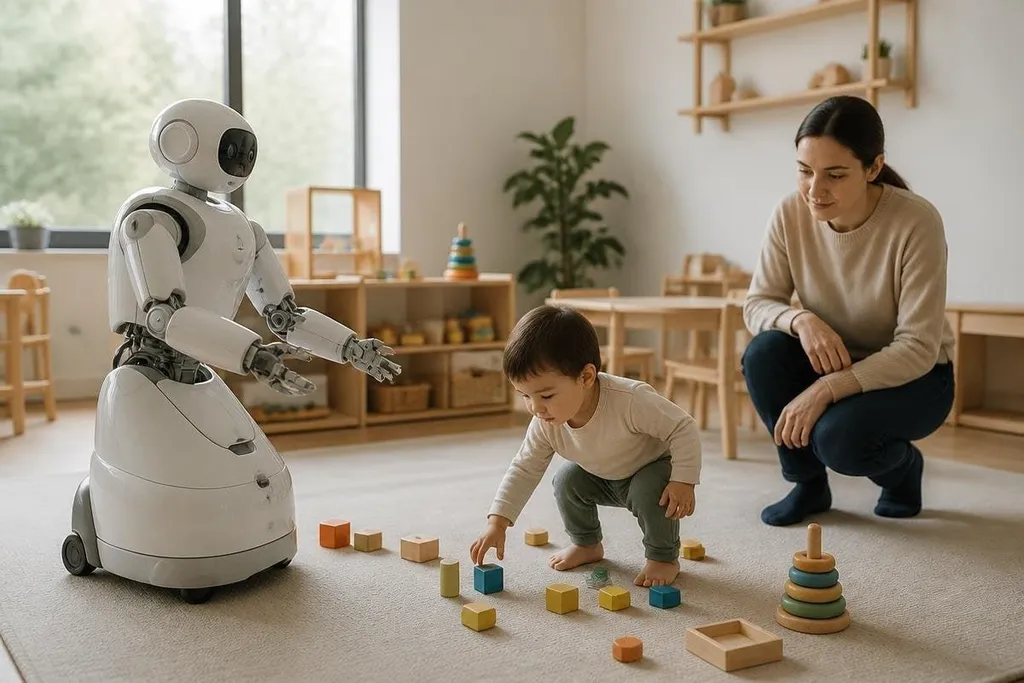
A childcare robot would face a harder job than a robot that carries boxes or cleans floors. It would need to read a child’s movement, respond to danger, and know when an adult must take over.
The main question is simple: can a robot help with childcare without creating a new safety problem?
- Safety comes first: A robot must stop safely around small, fast-moving people.
- Useful work is limited: Feeding, play, and reminders need different skills.
- Adult control stays central: A caregiver must be able to intervene at once.
What a childcare robot could do
The first useful systems are more likely to handle narrow tasks than act as an all-purpose nanny. A robot could carry toys, bring a bottle, read a story, or remind a child about a routine. Each task gives engineers a clear result to check.
Cameras, microphones, and other sensors could help watch a room. Those tools can detect movement and sound, but detection is not the same as understanding.
A child crying near a table might need comfort, first aid, or a parent. The robot would need enough context to choose a safe response.
Physical work creates another limit. If it lifts a toy, the robot may push too hard when a child grabs it. Its arm, wheels, or gripper could also block a doorway or reach a place where a child should not be. Safe speed, force limits, and a large emergency stop would matter more than a smooth voice.
The hard part is safe judgment
Children change plans quickly. They run, fall, hide, climb, and pick up objects that adults would move out of reach. A home robot would need to handle those changes without treating every unusual movement as a normal task.
That calls for layered safety. The robot would need a way to sense nearby people, slow its motors, stop when its view is blocked, and hand control to an adult. A remote video feed could help, though a delayed feed would leave the adult reacting after the event.
Privacy would need the same care. Cameras and microphones placed in a child’s room can collect sensitive data. Parents would need clear settings for storage, access, deletion, and remote viewing. A system that sends recordings to a server would need to explain that path in plain language.
The useful record would show whether a childcare robot was tested with families, what adults had to do, and how it handled stored recordings. A dated report from Robot24 can place those details beside the maker’s claims before the next section examines what remains unproven.
What remains unproven
A staged demonstration can show that a robot completes one task. It does not show how the system behaves after a child changes the scene, blocks a sensor, or asks for help during two events at once.
The missing proof is long-term safety around real children. That proof would need named test sites, clear supervision rules, records of failures, and results from more than one type of home or care setting. Marketing videos cannot supply those details.
Cost matters too. A family would need the robot, software, repairs, charging equipment, and perhaps a paid remote service. Without verified prices, it is impossible to judge if the machine could replace paid childcare, reduce adult workload, or remain an expensive helper.
I'd skip any childcare robot that cannot show its stop rules, data settings, repair plan, and adult handoff before purchase.
A buyer’s safety checklist
Use these checks before you consider a system for a child:
- Ask for task limits: Get a written list of jobs the robot may perform and jobs it must refuse.
- Test the stop control: Check how an adult stops motion from across the room and after a network failure.
- Check sensor failures: Ask what happens when a camera is covered, lighting changes, or a child leaves the robot’s view.
- Read the data policy: Find out where recordings go, how long they stay there, and who can open them.
- Plan adult cover: Keep a caregiver responsible for the child while the robot runs.
- Price the whole system: Include service fees, batteries, repairs, and replacement parts.
The next useful step is a small, supervised trial with a narrow task and a written record of every stop, error, and adult takeover. Until those results are public, childcare robots belong in carefully watched support roles, not in charge of a child.